Skip to content
  • Here I Am, But Who Are You?

    September 23, 2025
    Conversations, Inspiration

    When I first started this blog, I struggled with how to categorize my posts. I’m a big fan of sorting and organizing—if you’re here to read about topics related to creativity and inspiration, you may not be interested in my rambling about what a Gymnopedist is or the impact of Red Note on global political movements. The challenge of categorization, though, led to a new question that I’d frankly been avoiding: Who is my audience? What’s the use of making categories for readers’ convenience if I don’t know who those readers are?

    I started with considering my existing readers, but that didn’t get me very far. I have a handful of friends who check on “Words, Words, Words” regularly, but the other engagement I’ve gotten has been from strangers who I imagine as creatives, musicians, artists, perpetual students, DIY enthusiasts, passionate hobbyists.

    But I don’t JUST want to write for that audience. I want to express creativity here, sure, but I also want to share my other thoughts. For better or for worse, I like engaging with larger cultural conversations. I want to write for everyone! And that doesn’t mean writing vaguely, or in a placating tone—I want freaks, outcasts, the uncomfortable, the oppressed, and those who are constantly treated as a fringe audience to be my primary audience.

    I like writing boring nonfiction that (let’s be honest) might appeal to maybe a handful of nerds. I don’t just want my audience to be the people I can think of. How do I balance being a “universal creator” with the realities of internet marketing? With SEO, keywords, and (most importantly, as everyone claims) a “target audience?” How do you craft the “everything-person” who’ll engage with all of your varied content, who’ll be as interested in poetry prompts as they are arguments for ghost hunting?

    This isn’t just a “me” issue. A friend is looking to expand to their content to other platforms, and as I’m trying to offer support I’m becoming increasingly aware of my own limits. How can I ask someone else to craft their “ideal reader” in order to develop a marketing strategy when I’m struggling to do it myself? Sure, there are other ways to gather information. Looking at already successful creators’ content (hashtags, keywords, caption structure, etc.) can give marketing direction for similar enterprises. But more professional sources than I insist on the importance of building a character the way fiction writers would do establish an “ideal” patron.

    I did what I often do when I’m unsure and lacking confidence: I poked through my personal library until I found a few relevant books. My verdict? Imagining, building, and celebrating readership requires unrealistic optimism and determined hope.

    The first relevant book I found is one I picked up during my freshman year of college, titled The Craft of Research. (I never actually read it all the way through at the time, but the annotations I did leave were helpful—thank you, past me!) The whole book is a helpful resource, but I was looking for some specific advice. Luckily I found it near the beginning (lucky because, as previously stated, I never read the entire book).

    Booth et al. (2016) suggest that you treat your audience like “scholars interested in greater knowledge and better understanding,” emphasizing that the writer should be “concerned with [their] particular community of readers” [parentheses in original] (25). That’s well and good, but then we run into the issue that plagues me, my friend, and other creatives who are avoiding exclusion—how do we imagine the individuals who make up that vague community?

    I like the metaphor Booth et al. (2016) use of readers as passerby. “You must think of your reader as someone who doesn’t know it but needs to and yourself as someone who will give her reason to want to know it” [parentheses in original] (18).

    This mindset requires that you take yourself out of your fantasy of creative solitude, temporarily casting off your role as a writer (or artist, or bedroom musician), and adopt the mindset of a street performer. What if you were preaching, dancing, or playing guitar on the side of the road? People will likely appreciate your efforts as they walk by, but how many will actually stop? If you only play to reach the specific people who are the type to stop, there’d be little point in playing at all. Sure, market strategy suggests that we flesh out those people who’d stop, but realistically, you’re playing for everyone else, too—even those who don’t think they need whatever you’re presenting to them.

    Another book I found helpful was They Say/I Say by Graff and Birkenstein. Opposite of performance, they describe the role of a reader as being in conversation with the writer. A conversation?! Now we aren’t just thinking up our own words—we’re thinking up words said by a (still difficult to picture) reader!

    Graff and Birkenstein suggest that we (as writers and readers) “imagine the author as participating in an ongoing, multisided conversation in which everyone is trying to persuade others to agree or at least to take his or her position seriously” (175). But that requires a scary amount of faith in your audience. Our perfect reader doesn’t exist, and our general reader will likely have different responses to content than the perfect reader.

    When considering the public, feedback can be a scary thing (and can make or break a creative’s relationship with their audience). It’s one thing to receive feedback on a work in progress, but what about something finished, something that you’re proud of? I would be remiss to not think about who my readers might be in the context of the current political climate—how much am I comfortable sharing, on my website or on Substack? I unlinked my Storygraph from a past post because I was embarrassed about a book I was reading; how can I expect myself to write meaningful, vulnerable pieces if I won’t even open up my reading list for discussion?

    The answer lies in that unreasonable optimism and determined hope we talked about earlier—you have to trust the reader to look “not just for the thesis of a text in isolation but for the view or views that motivate that thesis” (Graff and Birkenstein 183). During a wave of anti-intellectualism and poor media literacy, I’m sure I’m not the only creative struggling with how to respond to general feedback after making your work available to the public (even if that feedback is only from an imaginary reader, because remember—we’re still developing an audience).

    Every time you engage with the world it’s a conversation. Every time. And with a conversation, there are a few ways you can concretely prepare. Consider: who are you talking to? What’s your message? And with both of those pieces of information, how do you get across your point?
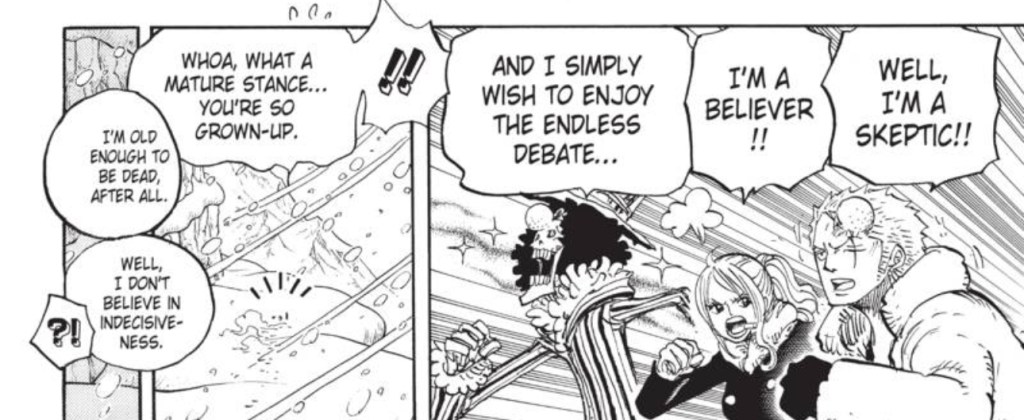
    A fun One Piece panel that highlights different types of audience feedback. Don’t just write for the believer or to spite the skeptic – remember that joy lies in the larger conversation! There’s a time and place to be indecisive, and sometimes it’s okay to not be sure. Panel from One Piece by Eiichiro Oda.

    And here we go again, back to the issue of defining one’s audience, a task impossible despite the fact that it’s a key part of advertising in the age of mass media. Yes, yes, planning is needed. I get it. But (sometimes unfortunately) I’m a figure-it-out-as-I-go type of person. And so here I am, writing it out. This post is certainly a conversation—one with the potential reader, with the imagined audience, in mind. And that audience is a mystery. I know who I am, but who are you? And how can I appeal to you?

    Realistically, I don’t know how to do that. There’s no way to make everyone happy. The Craft of Research suggests that “even if you don’t have [your goal] audience right now, you must write as if you do” (19). Being a “successful” creative, regardless of how you imagine that, means that at a certain point you have to break away from “reality.” The reality of business planning that tries to create a specific reader who, let’s be honest, doesn’t exist. But you have to imagine, because how will you find your target audience if you don’t even try to meet them?

    And so I will write. And for the sake of my multifaceted (dream) audience, I will try to sort my writing, no matter how weird and purposeless it is, no matter if people read it or not (although being read is certainly the goal). So for my writing that’s vague, that’s not a prompt, that requires considering a more complex audience, I settled on the category title of “Conversations”. Ultimately, that’s what writing is. That’s what any kind of outreach to the world is. It’s a conversation. And I love to yap.

    (And in the spirit of vulnerability and conversation, here’s the link to my Storygraph.)
    No comments on Here I Am, But Who Are You?
  • What is a Gymnopedist?

    August 30, 2025
    Conversations, Inspiration

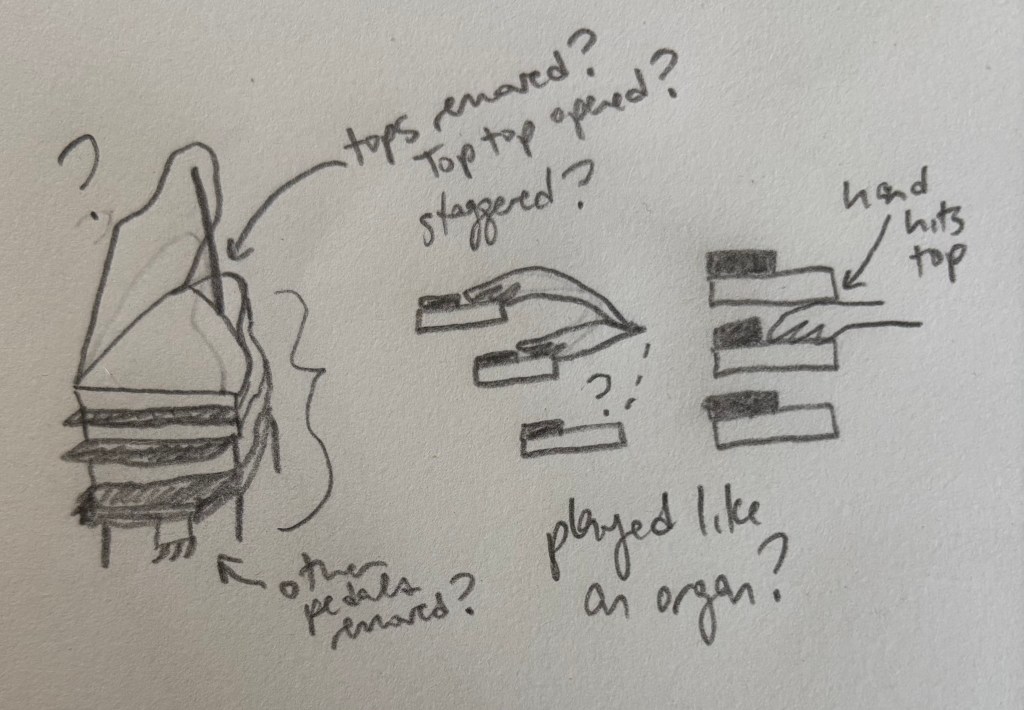
    You’ve probably heard Gymnopedie No. 1 by Erik Satie. While the piece has been around since 1888, I never noticed it until my piano teacher opened to its page in the repertoire book and got my attention by telling me that after Satie died, they entered his apartment to find three grand pianos stacked on top of each other. I’ve always liked playing pieces in minor keys that drag on with slow, swelling tension, and so my love for Gymnopedie No. 1 seems inevitable in hindsight. But initially, the story about his bizarre musical innovation stuck with me more than the piece itself did, and was my motivation for practicing. (NOTE: Shortly after this article was originally posted I learned that they actually only found two grand pianos. Only slightly less weird.)

    And who helped him move the pianos? I have so many questions.

    Gymnopedie No. 1 is deceptively simple. It was literally written to be background music. It’s aged into the public domain, fulfilling its purpose of being present but barely noticeable. My teacher referred to the Trois Gymnopedies (Satie wrote three pieces named Gymnopedie in total) as “furniture music.” Others consider them to be the ancestor of modern ambient music. While Satie himself was relatively uninterested in technological or cultural advancement, he nonetheless set the stage for a completely new sound.

    Unlike many pieces at the time that were intended to directly entertain, Satie put time towards writing music that people would hear, but not listen to. Trust me, once you can recognize the lilting melody of Gymnopedie No. 1, you’ll hear it when you least expect it (it’s like the Garfield effect). I was shocked to boot up my friend Violet’s video game, Every Letter, and hear its familiar haunting melody on the loading screen. I think the piece, arguably Satie’s magnum opus, has even become a TikTok sound.

    It’s hard to explain what a “Gymnopedie” is. It isn’t a traditional style of music, but weirdly, the name serves a similar function to the titles of classical pieces. Musical compositions, regardless of instrument, were often titled with the kind of dance that would accompany them. Like a Waltz or Minuet, the Gymnopedie is related to a type of dance. But as the definition (found in Peter Lichtenthal’s Dictionnaire de Musique) clarifies, this dance is uniquely performed in the nude.

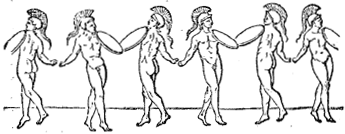
    The dancing of Gymnopaedia was traditionally performed in the nude. The piano piece, however, is usually not.
    Wood engraving from William Smith’s (1813-1893) Dictionary of Greek and Roman Antiquities. PD-US-expired.

    The word “Gymnopedie” is derived from Gymnopaedia, a Spartan coming-of-age festival featuring high-energy dances performed by groups of young, adult, and elderly men. Although the dynamic movement in extreme heat highlighted Gymnopaedia as a test of physical endurance for the young men, proving their masculinity, it also reinforced Spartan community values and bonds.

    Now that we’ve taken a brief detour from a genre-inspiring piece into ancient Spartan coming-of-age rituals, let’s turn to the composer of the Trois Gymnopedies, Erik Satie, the Father of Furniture Music. Satie did more than compose a piece referencing Gymnopaedia—he personally identified as a “Gymnopedist.”

    And that brings us to the question I’ve had for years: What is a Gymnopedist? What does it mean to try and personify, in one’s behaviors, ideologies, and habits, the character of a lively Spartan ritual celebrating transitions?

    I’d argue that Satie’s identification as a Gymnopedist partially references the “coming of age” aspect of Gymnopaedia. Satie took on an unusual amount of distinct aesthetic eras over his 59 years of life, and I can only imagine that he enjoyed fresh starts, if not the entire process of rebirth.

    Maybe an inspiration, but certainly a spectacle. Henri Manuel, Public domain, via Wikimedia Commons.

    During one period, he carried a hammer with him everywhere he went. He had a period where he embodied the Bohemian aesthetic. He founded the Eglise Metropolitane d’Art de Jesus Conductor—a religion with one member (him)—during his years as a “priest;” nothing became of this religion, and in the Gymnopaedic spirit of rebirth, he ended what would come to be known as his “mystic period” to embrace velvet eccentricity. His final aesthetic era was marked by a bougie bowler hat, a wing collar, and the constant presence of an umbrella on his arm. After his death, they found (in addition to the three grand pianos) 100 umbrellas in his apartment, presumably to ensure he was never without such a critical part of his look.

    Complimenting the spirit of transformation, the other aspect of the Gymnopaedia that Satie might have connected with identifies the Gymnopedist as a spectacle. Ancient people traveled from all over to witness the Gymnopaedia, even those who had no connection to the performers. Do the Spartan men transition to the next stage of their lives unless the crowd witnesses them do so? What’s the point of the effort put into meaningful change if no one recognizes it?

    The act of creation itself isn’t necessarily a massive spectacle. The creator views their creation, but Satie shows us that a greater creative spectacle happens when something is viewed by the world, and is what keeps us interesting. We do not have to be spectacles—but in the spirit of authenticity, of embracing change, and celebrating ourselves—we can choose to be.

    Prendergast, Mark. “The Ambient Century: From Mahler to Moby.” The Evolution of Sound in the Electronic Age. page 6. ISBN 0-7475-5732-2

    Lichtenthal, Peter. 1839. “Gymnopedia.” Dictionnaire de Musique, Vol. 1 A–J. Translated by Dominique Mondo. Paris: Au Bureau de la France Musicale. p. 496.

    Powell, Anton; Flower, Michael A. 2018. “Spartan Religion.” A Companion to Sparta. pp. 425–451. ISBN 978-1-4051-8869-2. OCLC 1029549436.

    Christesen, Paul; Donald, G. Kyle. 2014. “Sport and Society in Sparta”. A Companion to Sport and Spectacle in Greek and Roman Antiquity. ISBN 978-1-118-61004-6. OCLC 1162072582.

    1 comment on What is a Gymnopedist?
  • Don’t Forget to Warm Up!

    August 16, 2025
    Inspiration

    When I was in high school, there was an ongoing debate about whether or not marching band counts as a sport. Personally, I think it definitely does; walking with proper form while carrying any kind of weight is physically challenging enough, but doing the breath work required for brass and woodwinds WHILE marching and carrying weights? It definitely takes more physical exertion than golf, and no one questions if that’s a sport!

    A lot of create endeavors don’t involve that much physical effort. I’m certainly not breaking a sweat as I sit here typing. That being said, no matter what you’re doing, you should still warm up!

    If you’re just starting to introduce structure to your practices, you might wonder why you need to warm up before embarking on a task. Since I’m primarily a pianist, I’m going to explain it through the lens of practicing an instrument. Try thinking about how it might relate to your personal creativity!

    I see warming up is a “grace period” when practicing. I like to play something simple and repetitive. Scales and arpeggios are common musical warm-ups for that reason. I also like Hanon and Czerny.

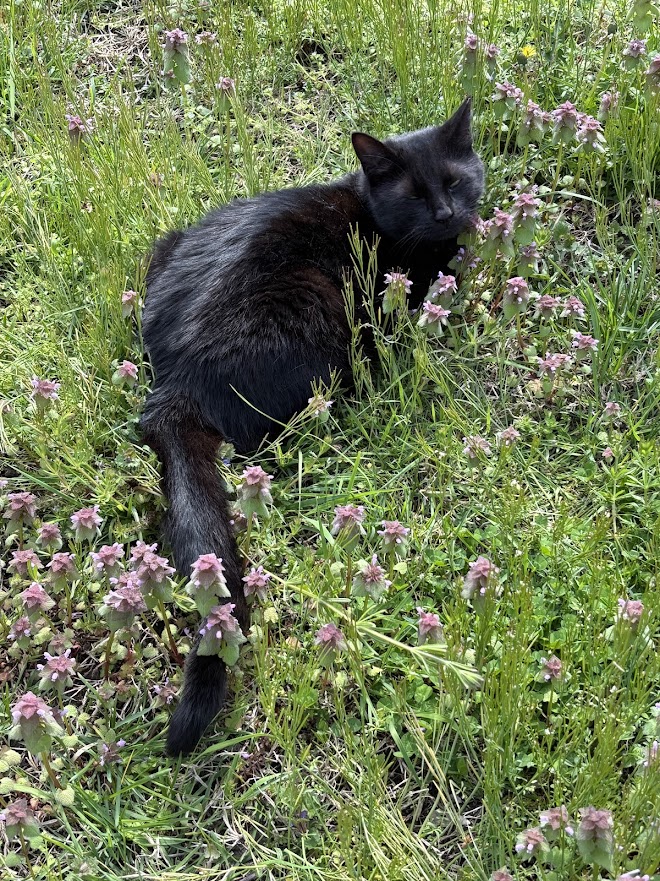
    Warming up cat-style: by laying in the Sun.

    The goal is to get your fingers comfortable moving—not to play it perfectly! You’re going to miss notes, and it won’t sound great, but this is the time to really focus on how good it feels to move your fingers, and be grateful for the ability to engage in your art from a physical sense.

    Warming up can feel like meditation; your mind can wander, but ultimately, you’ll return to the familiar motion of your fingers like breathing. It’s grounding before you move onto what comes next—whether that’s a difficult piece you’re working on, or if you decide (after giving yourself a chance to be relaxed and have fun) that you’d rather not do anything more serious today, that’s alright! Warming up just helps us remember that the act of creation is just as fun as experiencing the product of our labor.

    It can be hard to motivate yourself to practice at all, let alone warm up. But the less you touch the keys (pick up the pencil, put on your slippers, go to the library), the less confidence you’ll feel in your drive and ability to do what you love!

    Right now, I may be a little rustier than I’d like, but I always know the first thing I’ll do when I practice is play some simple, repetitive exercises to loosen up. Most of the time, warming up is all it takes to break through to creative confidence, getting into a nice groove for the rest of practice where I’ll be enjoying myself even when things get difficult.

    Marching bands train in a large, structured musical environment, meaning that the community as a whole holds each other to a high standard that can only be met by warming up. Many creatives aren’t set up like that, and the best we can have is our own standard. If you aren’t sure where your standard is, or where to begin, don’t let that keep you from action—just start with a warm-up.

    No comments on Don’t Forget to Warm Up!
  • A Poetry Cheat Code

    July 12, 2025
    Inspiration
    A Poetry Cheat Code

    Poetry. Everyone loves to hate it. (Unless you’re my old advanced poetry professor who openly, genuinely loved poetry and hated her students.) But it’s a bizarre thing. Somehow random jumbles of words say things more clearly, and with more weight, than if the message was directly laid out for us. Why is that?

    And what IS a poem? They don’t have to rhyme. They don’t have to be long (hypothetically, a poem could just be a title and a single word or a line of numbers. A different old poetry professor argued that poetry has limits—for example, poetry was not the commercialized text inside of greeting cards. It seems there are limits to what counts as poetry, and one of the determinants of a poem is the emotional meaning.

    Okay. So how to we craft a poem with a stronger emotional meaning than a Hallmark card? Poems are puzzles of words. It feels impossible to jump right into poetry and expel the same complex magic as Mary Oliver (I finished Devotions recently, and it was definitely magical). But writing poetry that you’re proud of, like anything else, doesn’t have to be complicated, scary, and out-of-reach! Here’s the best poem inspiration exercise I’ve ever learned (from a different professor, this one with hands in fiction and photography).

    First, find a text that you like. It can be song lyrics, someone else’s poem (because yours hasn’t been written yet, remember?), a TED Talk that motivates you, a monologue from your favorite movie…you get it. For my example, I’m going to use this line Marcellus says near the beginning of Hamlet:

    Horatio says ’tis but our fantasy,
    And will not let belief take hold of him
    Touching this dreaded sight, twice seen of us:
    Therefore I have entreated him along
    With us to watch the minutes of this night;
    That if again this apparition come,
    He may approve our eyes and speak to it.

    Now, rewrite it with opposites! Up is down, left is right, and yes is no are obvious ones, but think of how creative you can get! Here’s my reverse-write of the lines I included above:

    I told Horatio it was all his fantasy
    but I will let belief let go of me.
    Recoiling from that beautiful sound,
    one that he’d never heard before.
    He told me to stay behind
    away from each other to listen to the hours of the day.

    If never again the human leaves,
    we will disapprove his ears and ignore it.

    It’s goofy, but it’s something! Let’s polish it up. Here’s the final product:

    I told Horatio he was imagining things,

    but I didn’t even believe myself.

    Together recoiling from a beautiful sound

    that we’d never heard before,

    he told me to stay behind him.

    Still, under that beautiful newness,

    we listened to the hours of the day.

    If never again humanity leaves,

    we will disapprove of the rumble of traffic hitting our ears

    and ignore it.

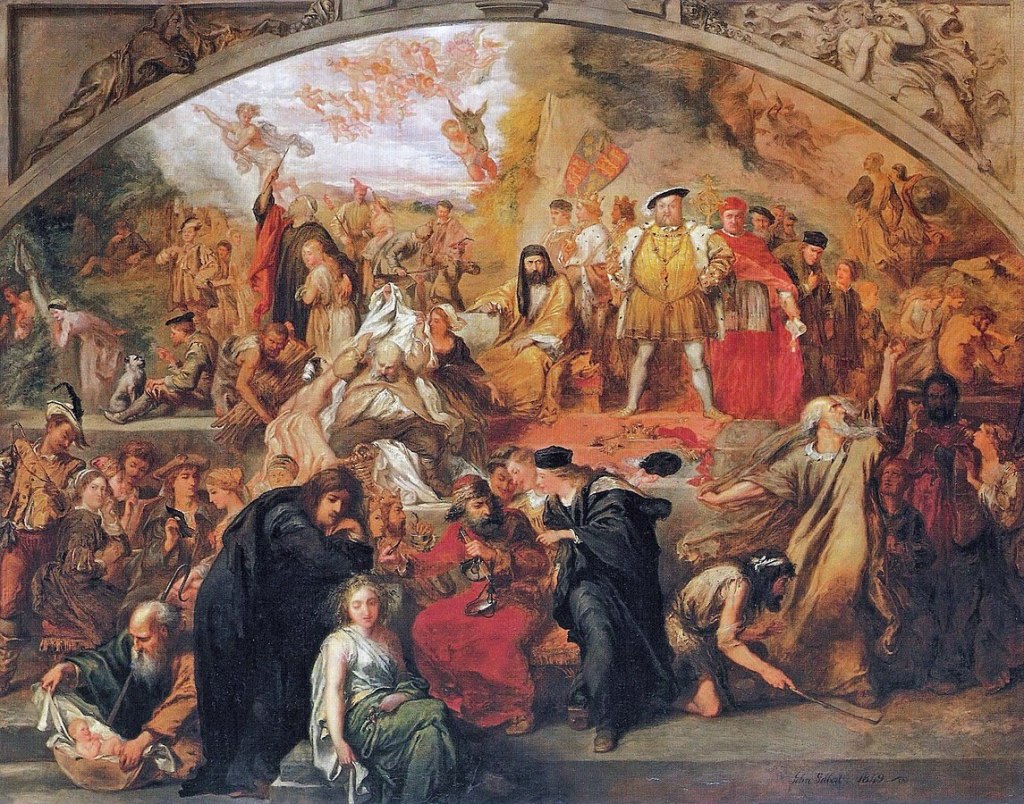
    I’m sure the man who gave us the phrases “puppy dog” and “skim milk” would be happy to let us “play” with his writing! “The Plays of William Shakespeare, a painting containing scenes and characters from several plays of Shakespeare (c. 1849), by Sir John Gilbert.” Public domain.

    Congratulations! We have a poem! Not only do we have a poem, but we have taken seven lines that I found after Googling the phrase “Hamlet first monologue” (there is no such thing) and made something halfway-decent that paints an image of Horatio and the speaker striving to hear nature under the sounds of industrialism. The preexisting theme from the original work (seeing a ghost) helps set the scene for a new theme in the reverse poem (nature being drowned out by traffic). Two totally unrelated concepts!

    Give this a try sometime! It’s one of my favorite word games, and the result is almost guaranteed to be weirdly profound!

    1 comment on A Poetry Cheat Code
  • Why You Should Try Ghost Hunting

    July 6, 2025
    Adventures, Inspiration

    I used to believe in ghosts. Then I stopped. Now, I kind of believe in them again. Emphasis on “kind of.”

    Have you ever looked for ghosts? I mean really looked for ghosts. Bloody Mary and Ouija boards are fun, sure. But at Waterworld, an abandoned water park located in beautiful eastern Pennsylvania, I saw a chance to take ghost-hunting a little more seriously. I’m going to cut to the chase now, before anyone jumps ship thinking this post is the ramblings of a crazy person: I don’t think most things are ghost evidence. While there was some weird stuff, it was the usual “weird stuff” that resulted from using equipment that I’d scraped together over the years. A broken clock is bound to be right twice a day, and a spirit box is bound to spit out a few timely syllables that can just as easily be considered nothing.

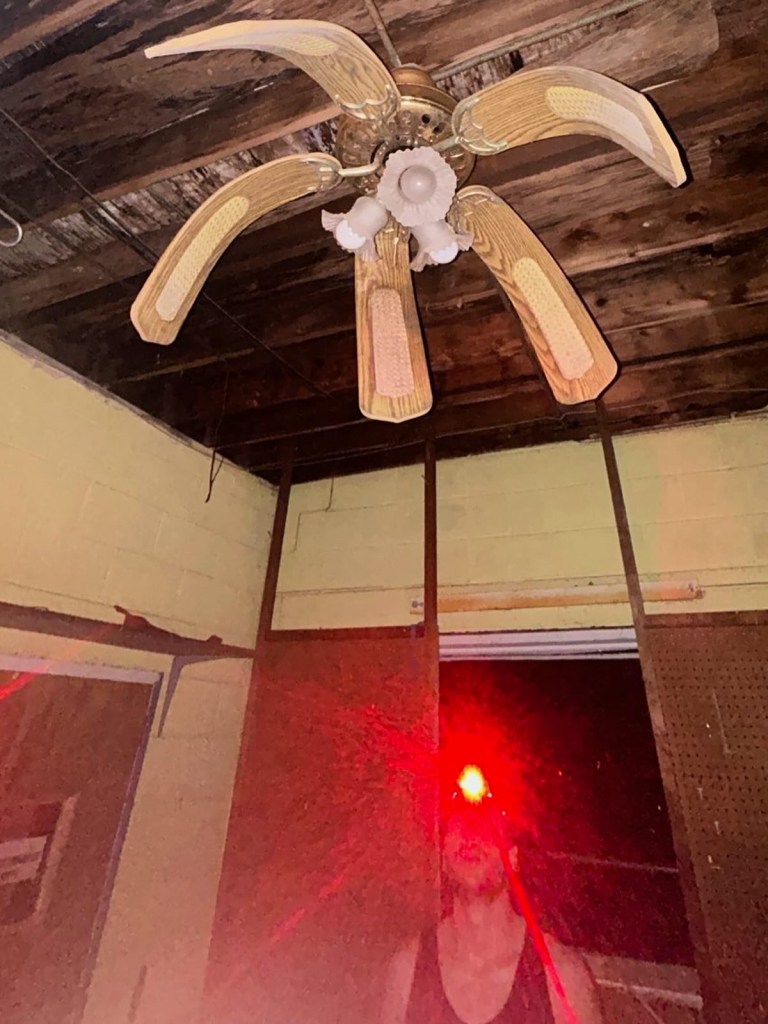
    That’s not an optical illusion–this ceiling fan looked like it had melted! Not a ghost, but not something I would have seen otherwise.

    But honestly? I don’t really care if ghosts are real or not. If they are, cool; if not, okay. I could have walked out of Waterworld having gotten no evidence, compelling or otherwise (and in most buildings, that was the case) and it still would have been a blast. It’s fun to get out of your comfort zone and challenge your knowledge—and it’s an important part of self-formation! But doing that in a real, physical sense is so much more different—and more satisfying—than just watching other people do things you think are cool. Why would I stick to watching videos of other people hunt ghosts when (whether I believe in ghosts or not) I can hunt for them myself?

    There seems to be a lot of pressure to not “do things” unless you’re an expert at them. Not to blame the internet, but we tend to see polished final projects more than we see works-in-progress online. So why bother to even start if your first accomplishment doesn’t look like an expert’s? The answer is surprisingly simple: because it’s fun! It’s fun to sing whether you sound like a crow or a blue jay. It’s fun to draw comics whether they’re stick figures or hyper-realistic portraits. It’s fun to hunt for ghosts even if you don’t believe in them, even if your “tools” are random items, even if you’ll never do it again.

    Try what strikes your fancy (within safe reason, of course)! You think it’s cool that people can play piano? Why not check it out for yourself? Worst case scenario, you don’t like it—but even then, you might have a fun story to tell!

    1 comment on Why You Should Try Ghost Hunting
  • Keep Learning!

    June 21, 2025
    Inspiration

    I recently graduated with my bachelors degree, a grueling but rewarding process that spanned three universities, seven years, and countless majors. I graduated just after my 25th birthday, too—my quarter-life crisis has been neatly accompanied by the freedom of no current academic obligation. In elementary school, the last day of school saw us released to the buses while the loudspeaker blared a song claiming that “School’s out forever!” It wasn’t true then, but it is now.

    By the time I finally picked the major I would graduate with (BS Anthropology in the Cultural/Linguistic concentration with a minor in New Media Communications) you might think that I would be sick and ready to be done with college. My mom certainly didn’t understand why I dragged on the process, and if I had to do it again, I wouldn’t do it that way (I wish I had explored intro courses at community college instead of jumping right into a major at a four-year institution).

    But I don’t regret the weird variety of classes I took as a result of my exploration. As a Physics major, I took Calculus II. I got a C, but by that point I had declared a Psychology and Theatre double major. I enjoyed Movement for Theatre, but I never wound up taking a psychology class (and I still haven’t!) because I changed to a Creative Writing major. I took an introductory workshop where I experimented with multilingual poetry and homoerotic fairy tales before changing to a Geography major, as I’d enjoyed a class on geomorphology…and then I dropped out for the first time (I would drop out two more times over the next five years).

    Finally graduating is something I’ve been looking forward to forever because it means that I can shift my focus to other topics. Sure, I enjoyed my classes, but everything was focused on the same general information. During my last two years of undergrad I’d made lists, obsessively, of degrees I could get and in what order—not just masters degrees, but multiple PhDs, and bachelors I could return to, and I could fit in associates somewhere—and a few months ago it hit me, really hit me, that it was a totally useless ritual. I’m determined to get a masters degree, and if I play my cards right I could maybe fund a PhD, but I don’t want to devote all my time to school, for the rest of my life. I have loved ones. I have hobbies. I know what I’d do with immortality, but let’s be real.

    This is for the nerds who would collect degrees like trading cards if they could. You want to keep learning, but reading a book isn’t enough. YouTube videos aren’t enough. It’s not a class. Where is the mentorship? The knowledge specifically crafted to give you the best overview of a subject? If you’re also an aspiring Jack-of-all-trades, you know that learning comes in all possible forms and opportunities. But if you’re specifically looking for a “classroom” style setting (albeit online and asynchronous, which personally I prefer), I’ve found some awesome free options.

    My top recommendation is Gale Courses. It’s entirely free through your local public library (and some libraries, like Enoch Pratt, will issue digital library cards on their website so you don’t have to go in in-person to access the courses).

    After I finished my undergrad work, I picked up a few Gale classes for fun to pass the summer—Classical Guitar, Travel Writing, Business Planning, Handling Medical Emergencies, and Intro to Drawing. No grades, nothing to turn in, but information and activities are given that actually help you learn. The best part? You have access to professionals who guide each course.

    Some warm up sketches! What do you see? Because I have no clue what half that stuff is.

    If you just want to lurk and see where you can get with Human Anatomy 101 on your own, that’s fine. But if you decide you want to get feedback on your writing in Guide to Getting Published, there’s a discussion area and an enthusiastic teacher waiting to engage.

    While Gale is my top pick for general online classes, it also requires a library card. If you want an online classroom in a click, check out Harvard Online—it has some awesome political science, biochemistry, and music history classes I want to take sometime.

    The fact is that college is expensive and increasingly inaccessible. You can do plenty of learning outside of academia, but if you’re looking for a more cultivated environment with feedback opportunities, check out what free online classes you can find. Who knows what you’ll find—and who knows how it’ll inspire you to create!

    No comments on Keep Learning!
  • Display Your Collections!

    June 17, 2025
    Inspiration
    Display Your Collections!

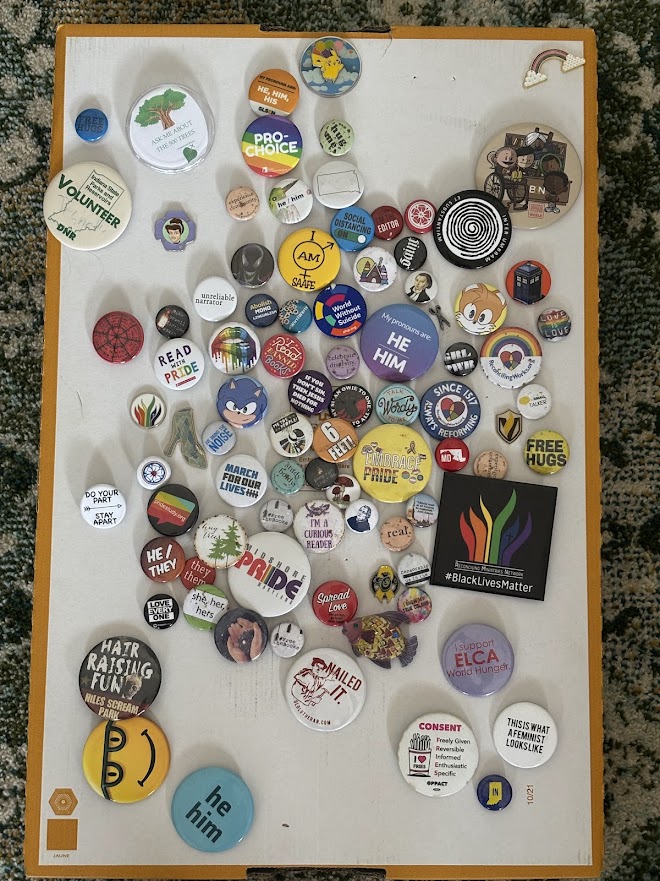
    It’s not hoarding if it’s cool. That’s what I’ve told myself as I’ve collected seashells, books, pins, keys…But when the items you’re “collecting” just sit around in buckets or jars, collecting dust on shelves or in a random bowl where they’re left in a cluttered stasis, it gets harder and harder to justify keeping it all around. You may feel compelled to throw it out.

    But wait! There’s another option!

    It was years before I thought about displaying my pin collection. I had moved into my first grown-up living situation and was faced with a vase full of pins I’d accumulated. They were on display during my first few weeks of college, before I realized it wasn’t cool to cover your backpack in buttons, but eventually they were condemned to a purgatory encased in some textured pink material that I don’t think is glass, but I can’t place what it is.

    Ready? Here’s how I went about it: I grabbed a clean, flat box from the recycling pile and stuck all the pins in it. After about 10 minutes I realized I could stick them in in aesthetically pleasing ways. After a half hour (during which I was rewatching Gravity Falls), I could see all my buttons for the first time in years.

    Here’s the thing: it’s an ugly display. It would never hang in a museum. I didn’t bother to paint the cardboard, so you can see the brand names printed on the bottom of the box (although to my credit, I did make sure to cover the one in the center with buttons). I didn’t even bother to cut off the extra sides. Point is, it was made and displayed in 30 minutes, and it looks like it. And I’ve never been prouder.

    It’s ugly, but it’s better than trapped in an urn!

    If your collection is rotting away somewhere, then you’ve already decided that you’re collecting it for yourself rather than for other people. Maybe your standards are higher than mine, and you’re shaking your head saying, “If I’m going to do this, I’m going to do it right!” Cool! But are you going to do that at all?

    It doesn’t have to be forever. An ugly display is better than no display. Give yourself the chance to regularly admire your collection! And if you crave something better, imagine how much more motivated you’ll be when you get to constantly look at your beloved collection in a decidedly mid position.

    It doesn’t have to look good by anyone’s standard but yours. You’ve accumulated things because you love them. Give yourself the chance to appreciate them.

    No comments on Display Your Collections!
  • The Newest Thing: The Movement from TikTok to Red Note

    June 9, 2025
    Conversations
    The Newest Thing: The Movement from TikTok to Red Note

    Benni is studying communications at Towson University. She works at a movie theater, grew up in rural Pennsylvania, and recently got a cat named Stinky. Her passions include Sonic the Hedgehog and Appalachian storytelling. She is also a #TikTokRefugee—one of many Americans who “left” the social media platform TikTok for the Chinese social media platform Xiaohongshu, better known to the American audience as Red Note.

    In January of 2025, American users of TikTok moved en masse to Red Note. The mass movement—or “migration”—of these users—or “refugees”—happened in response to threats that the United States government was going to censor the app, blocking Americans’ access to free, short-form video content. This ban would have real-world consequences: countless small businesses in the United States are able to function because of the following they’ve amassed on TikTok. Economics aside, banning the app raises concerns of censorship, with the United States government facing accusations that the frantic push to ban TikTok is due to how well it spreads information that undermines political goals. Months later, TikTok has been briefly banned, unbanned but removed from the App Store, and then made available for download again about a month after it was banned in the first place.

    So why did Benni download Red Note? As part of that wider political movement. “My understanding was that Trump and other social media like Meta kind of dominate, and they were upset that the youth were enjoying things that were not made by Americans,” she explained. 

    Photo by Cottonbro Studio

    And the research says she’s not wrong. The International Communication Gazette notes that when it comes to internet censorship, the west is suspicious of TikTok. “Nine out of the 10 countries that banned only TikTok were western. The geographic distribution of the platform censorship…suggests that western countries are mostly interested in banning TikTok instead of other platforms” (Al-Zaman 2024). Social media platforms regularly clash with Asian governments in particular over issues related to free speech and censorship, alleging a correlation between increased censorship and less democracy that favors the perspective of the west.

    No changes have happened since TikTok reappeared on the app store. The idea of a TikTok ban is currently not mainstream concern. Neither is the presence of Americans on Red Note, which has noticeably decreased. But couldn’t there be more? It seems there should have been connections made, there should have been some noticeable empowerment among the people, gained from the interactions between average Americans and average Chinese citizens.

    Dr. Xeurong Lu, an Assistant Professor in the School of Communication at Oregon State University, connected the flat-lining of activity to larger concerns about civil engagement. “Social media is supposed to make activism easier and get people more engaged. On the other side, we also see that some activities only happen online.” So many Americans joined Red Note and engaged with Chinese users. The Chinese users, “native” to the app, welcomed the Americans. It was an easy and positive example of mass political action. But how much does it really matter if it was only digital?

    Photo by Markus Spiske

    Following the Unfamiliar Road

    Dr. Lu described the Red Note Migration as a process of organization and promotion. She observed that the app collaborated with American influencers on TikTok to present Red Note as a platform with limited moderation in a stark contrast to the censorship TikTok was facing. It was successfully enticing—people like to find out information for themselves, and it’s easy enough to sign up for an app. They were looking for a platform that was actively the opposite of the government’s suggestion, and that cultural desire—mixed with the social pressure of promotion— compelled more and more people to join Red Note.

    There are a variety of reasons why people seek out social media platforms. The Journal of Business Research lists countless reasons why individuals might join a site: They have concern for others, they seek social benefits and advice, they want company and a way to pass the time. Social platforms offer utility, entertainment, and more—the value of which can’t be overstated in a digital world (Azer et al. 2021). But the average user isn’t normally thinking about all of that. The #TikTokRefugees, however, were—and they considered their ability to access content without censorship to be political enough to respond to in an organized manner.

    Everything is Political

    As the internet becomes more widely-used, people ironically seem to be less involved in real-life politics. People are expressing active frustration towards formal representative democracy, and the internet is both seen as and used as a way to “increase citizen participation and hence legitimize the representative democratic system” (Klinger and Svensson 2015). It is easier than ever for people to socialize with like-minded individuals from the comfort of their own homes, forming social networks based on interest instead of location.

    Photo by Afta Putta Gunawan

    Danlu Yang, a PhD student in Anthropology at Oregon State University, sees the situation as a social movement that’s transcending borders. “The push to ban TikTok has ironically encouraged more Americans to engage directly with Chinese netizens,” she explained. “This is a positive development—it opens the door for both sides to recognize the limitations within their respective systems.” It is her last point about recognizing the limitations within the citizen’s systems that seems as if it would be the most relevant in the long-term, but the recognition of limitations didn’t seem to lead to any motivation to challenge those limitations. Well, most of them, anyway.

    Dr. Lu brought up a unique limitation that actually was challenged: state regulation of the media. “Because of society, people don’t trust the government or media and want to find things on their own.” Because pushing these limits happened online, in a cheeky-but-legal manner, the “Red Note Migration” can be considered less of a social crisis and more of a type of entertainment. That entertainment is political—it’s long been suggested that social media makes civil engagement easier, and certainly the movement to Red Note successfully caught mainstream attention. But ease doesn’t translate to effectiveness. “We see that activities only happen online. Good engagement should have some offline reactions.” Social media may be effective for engagement, but Dr. Lu observes that it can be considered harmful in the sense that it reduces offline engagement.

    Long-term Cultural Impacts

    In an article titled “Teaching Global Social Media Through Ethnography,” J. M. Sinanan writes that images posted on social media are helpful for teaching youth about other cultures, making them aware of global concerns and inspiring political activism. “Students didn’t just ‘see examples’ of posts, but they were introduced to…the individuals who originated such perspectives” (Sinanan 2020, 44). This is a formal way of saying that social media shows off the everyday to everyone, everywhere, creating interpersonal connections between ordinary global citizens—not just representatives from different nation-states shaking hands. For example, Benni’s only post on Red Note was an invitation for people to follow her. She listed some of her interests and included cute pictures of animals. “I wanted to gain a community like on TikTok, even though I wasn’t really in TikTok communities.” 

    She wasn’t the only American, though, and described at one point feeling frustrated at how some other #TikTokRefugees were behaving. “They were trying to turn it into TikTok and disrupt a pre-made community. Like we’re trying to Americanize this app.” There are countless creators on TikTok, and those who are able to make money off of the app do so by engaging with their followers. The immediate commodification of Red Note by American users trying to rapidly rebuild social and economic capital threatened the peer relations on the app, a kind of digital colonization.

    Benni considers herself on the other end, as a new user who introduced themself as American and posted a “get to know me” to encourage engagement. Deliberately reaching out between nations, past borders, and among the people. Not for the sake of making money, but for the sake of making friends.

    Photo by Burak The Weekender

    That ship has, for the most part, sailed. “The engagement peaks have passed,” Dr. Lu noted. “With so many interesting things happening on Chinese social media, no one’s attention stays in one place for long. For Chinese citizens, it was just one moment in their lives online.” She also doesn’t observe much difference in behavior from Americans. In the age of information, everything happens so fast.

    Moving Forward (in Digital Place)

    But that doesn’t mean it’s over. “Yeah, I still kinda use it here and there,” shared Benni. She’ll jump on, scroll a bit, like some posts, and check her DMs to revisit a conversation she had with a friend she’d made through the app, although they haven’t really kept in contact. Regardless of the political fears about the spread of anti-American sentiments, she was ultimately just looking for a place to belong. 

    Despite the apparent lack of long-term political influence, Danlu, who also observed the Red Note Migration through the app, shared that she felt that the interactions between American and Chinese netizens have been surprisingly open and peaceful. “It’s commendable that average American users are venturing into a Chinese digital space, often navigating language and cultural barriers. Their presence is transforming the app into a more international platform, now featuring translation buttons and IP addresses from around the world. This grassroots exchange is a quiet but powerful gesture toward digital cosmopolitanism.” Even if things may not seem to have changed politically from an immediate standpoint, smaller cross-cultural interactions can be indicative of larger global cultural movements. Any “influence” from this event will likely be one part of a series of smaller actions, but that doesn’t make this one any less relevant.

    2 comments on The Newest Thing: The Movement from TikTok to Red Note

Create a website or blog at WordPress.com

Vincent Boone-Banko

Create Boldly

  • Piano Services
  • About Me
  • Music Writing and Composition
  • Words Words Words
  • Contact
Loading Comments...
  • Subscribe Subscribed
    • Vincent Boone-Banko
    • Already have a WordPress.com account? Log in now.
    • Vincent Boone-Banko
    • Subscribe Subscribed
    • Sign up
    • Log in
    • Report this content
    • View site in Reader
    • Manage subscriptions
    • Collapse this bar